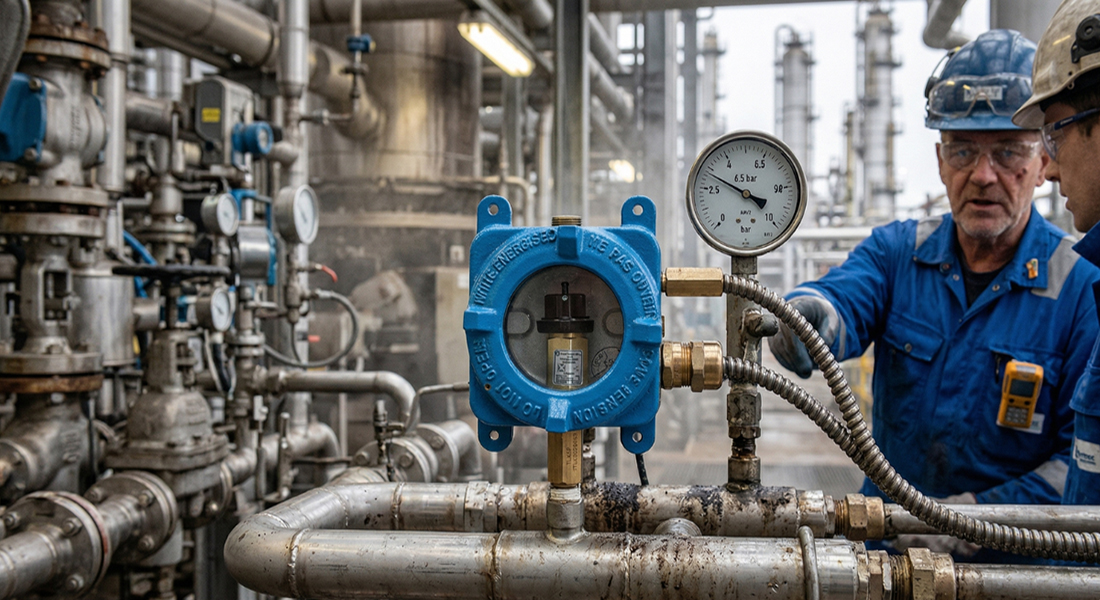
In sectors where industrial processes involve the presence of flammable gases, vapors, or dust, the choice of instrumentation is not a matter of technical preference—it is a regulatory obligation. The ATEX directive and the international IECEx scheme clearly define which devices can be installed in areas classified as explosion-risk zones and according to which protection methods. Complying with these requirements does not simply mean adhering to the law—it means protecting plants, operators, and production continuity from scenarios that, without proper precautions, may have irreversible consequences.
What are the ATEX directive and the IECEx scheme
The ATEX directive—an acronym for Atmosphères Explosibles—is the European regulatory reference for devices intended for potentially explosive environments. It classifies zones based on the frequency and duration of the presence of explosive atmospheres and defines the protection categories allowed for each of them. The IECEx scheme is the international equivalent, developed by the International Electrotechnical Commission as a certification system recognized outside European borders: while the ATEX directive is binding within European Union member states, the IECEx scheme ensures recognition of compliance in non-European markets, making dual certification a key tool for companies operating on a global scale.
Obtaining these certifications requires evaluation by an accredited third-party body, which verifies not only the product’s technical documentation but also the manufacturer’s production processes and quality system. Elettrotec has developed a range of ATEX and IECEx certified products, allowing designers and plant managers to qualify instrumentation with the assurance that it has already been assessed according to the highest international regulatory standards.
Discover the difference between ATEX and IECEx.
Types of protection: intrinsic safety and flameproof enclosure
There is no single protection method for explosive environments: regulations provide several, each suited to specific conditions. The two main ones included in our certified range are intrinsic safety and flameproof enclosure.
Intrinsic safety
Intrinsic safety (designation Ex ia) addresses the issue at its source: it limits electrical energy in circuits below the minimum level required to trigger an explosion, even under fault conditions. The Ex ia designation is the most stringent provided by the regulations and allows use in the highest-risk zones, where explosive atmospheres are continuously or frequently present. It is the solution adopted in our ATEX adjustable diaphragm and piston pressure switches, vacuum switches, and most level switches.
Flameproof enclosure
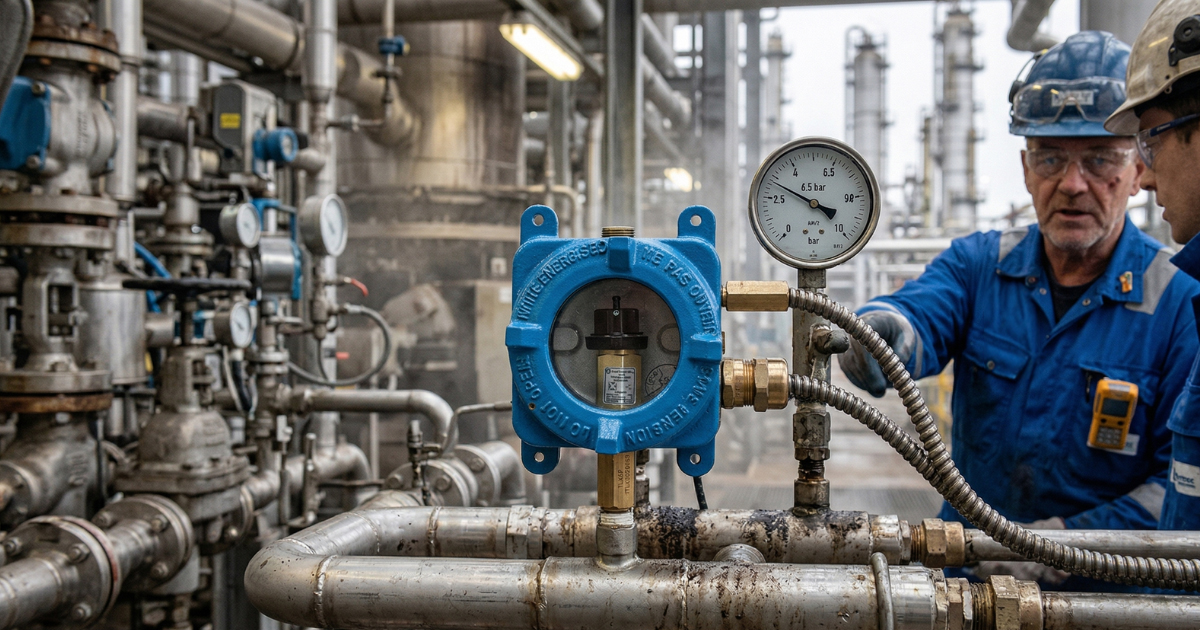
Flameproof enclosure (designation Ex d) follows a different approach: it does not prevent ignition but contains it within an enclosure designed to withstand the pressure of the internal explosion and to cool it sufficiently to prevent propagation outside. This is the principle behind the characteristic protective blue housing found on our level switches and flameproof level probes. The range also includes protection against dust, designated Ex t, completing regulatory coverage for all main types of classified zones.
The Elettrotec ATEX and IECEx certified range
Our certified range covers four product families, designed for process monitoring and control in plants with fluids or atmospheres at risk.
ATEX pressure switches
The intrinsically safe adjustable ATEX pressure switches cover diaphragm and piston technologies, with variants that include the PSM…EP approved assembly —already certified in its complete configuration—and models with double changeover contacts for managing two independent thresholds. The family is completed by the PMC/PMC…D, PPC/PPCF and PML-PPL models, which together provide full coverage of the main pressure measurement requirements in classified zones.
ATEX vacuum switches
The ATEX VSM vacuum switch extends certified coverage to vacuum applications, in intrinsically safe design. In processes operating under vacuum with flammable fluids—a common condition in the chemical and pharmaceutical industries—having a vacuum switch certified for classified zones is a technical and regulatory requirement that leaves no room for compromise.
ATEX level switches
ATEX level switches represent the most extensive family in the range and are available in two types of protection. Intrinsically safe versions come in numerous configurations, including stainless steel variants for environments with aggressive fluids. Flameproof versions—recognizable by the characteristic protective blue enclosure—include standard flameproof level switches, stainless steel versions and and models with 3 or 4 floats for multi-threshold monitoring in tanks with multiple switching levels.
ATEX level probes
ATEX flameproof level probes complete the range with solutions for continuous detection in tanks containing flammable liquids, also available in stainless steel versions for applications with corrosive fluids. Designed with Ex-d protection, they are intended for sectors with the most stringent safety requirements, including Oil & Gas and petrochemical industries.
Conclusion
ATEX and IECEx certification is the essential starting point for any designer or plant manager operating in sectors such as Oil & Gas, chemical, petrochemical, or pharmaceutical.
Relying on a certified partner like Elettrotec means reducing qualification time, simplifying plant documentation, and operating with the certainty that installed devices meet the most stringent international regulatory requirements.
For more details on each product or to receive support in selection, the Elettrotec team is available for direct technical consultation.